Last updated November 18, 2026








Free written scope consultation - allowances, timeline, and change-order rules on paper before a single trade is scheduled
Bathroom Remodeling Maintenance Schedule: What to Do and When
Silicone caulk at the tub-to-tile joint is a sacrificial joint by design. It’s meant to be cut out and replaced every three to five years, and when it fails, water doesn’t announce itself. It finds the substrate. That isn’t a defect in your remodel, and it isn’t a warranty claim. It’s a maintenance item nobody hands you a schedule for, because most contractors don’t write one. Over the next few thousand words we’ll give you the schedule: what to check at 30 days, 6 months, annually, and year three, which products suit which finish, and where the line sits between your responsibility and ours. We’ll write it from Concord, where the summer swings and winter rain put specific demands on a bathroom that a Phoenix or Miami schedule would ignore.
Quick Answer
A bathroom remodel needs a written maintenance schedule: inspect and touch up caulk and grout at 30 days, clean the exhaust fan and check supply lines at 6 months, reseal porous tile grout and test the pressure-balancing valve annually, and plan to cut out and replace silicone caulk every 3 to 5 years. Skip the first 12 months and a 10-year tile job can fail in 4. The work you do right after the remodel decides how long it lasts.
Styles & brands we work with
- Kitchen remodeling
- Bathroom remodeling
- Home additions & ADU
- Roofing
- Windows & doors
- Driveway & pavers
- Fence
Table of Contents
- Why the First 12 Months Decide the Life of the Job
- The 30-Day Inspection: What to Check After the Remodel
- The 6-Month Tasks: Exhaust, Supply Lines, and Fixtures
- The Annual Service: Grout, Caulk, and the Pressure-Balancing Valve
- The 3-Year Replacement: Caulk, Aerators, and Seals
- Grout Sealing: Which Types Need It and Which Don’t
- Exhaust Fan Maintenance in Concord’s Climate
- Maintenance Item vs. Warranty Item: Where the Line Sits
- Common Mistakes to Avoid
- When to Call a Professional
- Frequently Asked Questions
Why the First 12 Months Decide the Life of the Job
A tile job doesn’t fail because the tile was bad. It fails because the waterproofing behind it got wet, and waterproofing is a system: a membrane, a substrate, a drainage plane, and a seal at every joint. The first year settles that system in. Materials move, caulk cures and shrinks a fraction, and grout lines see their first real moisture load. If you catch the small stuff in that window, you keep the waterproofing intact for a decade. Miss it, and you’re paying to tear out tile instead of replacing a $9 tube of silicone.
We’ve seen this play out across Concord. The Rancho del Diablo and Clayton Valley homes built in the 1960s and 1970s often have original cast-iron drains and galvanized supply lines, so a remodel is frequently the first time those get touched. The Concord basin also swings from dry, hot summers to wet winters, and a bathroom that sits over an unvented crawl space sees more condensation than homeowners expect. That cycle stresses caulk and grout joints in a way that a stable coastal climate doesn’t.
In our experience, the homeowners who get the full life out of a remodel are the ones who treat the first year like a settling-in period, not a finished product. Our technicians have up to 22 years of experience, and the pattern is consistent: the callbacks we see are almost always maintenance items that went unaddressed, not installation failures. A closed envelope and a maintenance rhythm are what make the difference.
The 30-Day Inspection: What to Check After the Remodel
One month after the last tile is set, most materials have finished their initial cure and movement. That’s the ideal moment to look for settling issues. Do this inspection with a flashlight and a dry rag, and don’t adjust anything permanently – just note and call.
- Inspect every caulk joint. Run a fingernail along the tub-to-tile line, the shower corners, and the sink backsplash. If the caulk pulls away from either surface, note it and call the contractor. In the first 30 days that’s likely a warranty item, not maintenance.
- Check grout lines for cracks or pinholes. Hairline cracks at wall-to-floor transitions are normal; a crack that’s wide enough to catch a fingernail is not. Photograph it.
- Test the exhaust fan. Hold a piece of toilet paper up to the grille with the fan on. It should hold. If it flutters and falls, airflow is weak and you should have it looked at.
- Confirm the shower pan drains fully. A slight slope is normal; standing water after 10 minutes is not. Note where it pools.
- Run both hot and cold on every fixture. Check that the pressure-balancing valve responds: flush a toilet while the shower runs and confirm the temperature doesn’t swing scalding. That test tells you the valve is set correctly.
- Check the toilet base. Rock the bowl gently. Any movement means the wax ring or the flange needs attention before it leaks into the floor.
- Look at the supply lines. Fingertip-check every braided line under the sink. A wet fitting in the first month is a warranty issue, not a maintenance one.
Write down what you find with dates and photos. A written record is what makes a warranty call clean rather than a debate about when the problem started.
The 6-Month Tasks: Exhaust, Supply Lines, and Fixtures
Six months in, ordinary wear starts. The bathroom has been through a Concord summer or winter, and the seasonal swing has done its work on caulk and grout. This is the first pass where you, the homeowner, own the tasks.
- Clean the exhaust fan grille and blade. Unplug the fan or kill the breaker first. Vacuum the grille, then wipe the blade with a damp cloth. Dust buildup cuts airflow more than most people expect, and airflow is what carries moisture out of the room.
- Inspect flexible supply lines under the sink. Look for bulging, discoloration, or moisture beads at the compression fittings. A braided line that’s bulging is a failure waiting to happen; shut the valve and get it replaced.
- Remove and rinse aerators. Unscrew the aerator from the faucet spout, rinse the screen, and reinstall. Concord’s water is moderately hard, so screen crud can cut flow within a year.
- Re-check caulk joints after the dry season. Caulk is most likely to separate as the house dries out. Touch up anything that has opened.
- Look at the tile face for efflorescence. A white crust on grout lines means moisture is moving through the grout. It’s a signal to reseal, not to scrub harder.
None of this takes more than an hour. But it’s the pass that separates a bathroom that’s maintained from one that gets a surprise tear-out. If you’re planning a larger scope soon, our Bathroom Remodeling in Concord page explains how a full remodel factors in.
The Annual Service: Grout, Caulk, and the Pressure-Balancing Valve
Once a year, budget an afternoon for the deeper checks. The annual pass is where you catch the slow problems while they’re still cheap.
- Re-seal porous grout. Test the sealer by dripping a little water on a grout line. If it beads, the sealer is intact. If it soaks in dark, it’s time to reseal. Use a penetrating sealer matched to your grout (more on that below).
- Test the pressure-balancing valve. Run the shower at a comfortable temperature, then flush a toilet. If the water temperature spikes, the valve has failed. That’s a safety issue and a warranty conversation, not something to fix with a wrench.
- Poke the caulk joints with the back of a plastic spoon. Soft, tacky caulk is fine; a joint that has shrunk, cracked, or molded is a maintenance item. Cut it out and replace it.
- Clean the shower door track and drain. A clogged drain is a two-step: pull the screen or grate, clear hair, and flush with hot water. Don’t use chemical drain cleaners regularly; they degrade older cast-iron and plastic joints.
- Check the toilet flapper and fill valve. Dye one tank. If color shows in the bowl without flushing, the flapper is seeping.
If you’re looking at other rooms after your bathroom, our Kitchen Remodeling in Concord page covers the same schedule logic for kitchens.
The 3-Year Replacement: Caulk, Aerators, and Seals
Three to five years is the practical life of the silicone in wet areas. It’s not a defect if it fails after 4 years – it’s the design life of the material. Cut it out, clean the joint, dry it fully, and install fresh 100% silicone rated for kitchen and bath.
- Cut out and replace the tub-to-tile silicone. Don’t caulk over old caulk. Cut out with a utility knife, scrape the residue, clean with denatured alcohol, and let dry overnight.
- Replace shower door seals and sweep strips. They harden, curl, and start carrying water past the frame.
- Replace the faucet aerator and check the cartridge. A cartridge that’s starting to seize is a $30 part now and a plumber’s bill later.
- Inspect the toilet wax ring. A toilet that has been sealed 3 years or more is a candidate for a fresh ring if the base ever moved. Check for rocking.
- Look for calcium buildup on the shower head. Soak in vinegar, or replace if it won’t clear. A restricted head is a sign your lines are taking scale.
Grout Sealing: Which Types Need It and Which Don’t
Here’s the point most guides skip: not all grout needs sealer, and sealing the wrong kind causes problems. Cementitious grout – the sanded and unsanded types used in most tile installations – is porous and does need sealing. Epoxy grout and single-component urethane grout do not, and sealing them wastes money and leaves a film.
- Sanded cementitious grout (most floor and large-format tile): seal once every 12 to 18 months with a penetrating sealer. Skip it and it takes on water, molds, and eventually crumbles from freeze-thaw movement in colder cycles.
- Unsanded cementitious grout (wall tile, small joints): seal annually. A failing sealer on wall grout is one of the fastest routes to efflorescence on the tile face.
- Epoxy grout (bath floors, walls): non-porous, no sealer needed. Clean with pH-neutral cleaner, not acid.
- Porous natural stone tile (travertine, marble): the stone itself needs sealer, not just the grout. Use a stone-specific penetrating sealer, not a tile-and-grout sealer, or you’ll cloud the finish.
When we use KraftMaid, Wellborn, and Kohler finishes in a bathroom, the grout and sealant schedule we hand the homeowner at closing is matched to the specific grout product used. That’s the standard the whole job gets measured by – our General Contractor in Concord page explains how we scope and document it.
Exhaust Fan Maintenance in Concord’s Climate
An exhaust fan that moves 50% of rated airflow is the same as no fan for moisture control. Concord’s dry summers and wet winters mean the home is wet in January and dry in August, so condensation cycles between seasons, and a bathroom that stays wet drives shower mold into the sheetrock within a year or two. The fan is your moisture path. Keep it clear and it works. Let it clog and the best waterproofing job in the county gets undermined by trapped humidity.
Here’s the practical maintenance:
- Clean the grille every 6 months, vacuuming the blade behind it. Dust on the blade is the biggest airflow killer.
- Verify the fan runs long enough. A fan should stay on 20 to 30 minutes after a shower. If the fan is wired to the light switch, install a timer.
- Run it during winter too. Cold walls plus warm showers means condensation; the fan is doing more work in January than July.
- Check the duct. A crushed or disconnected flex duct in the attic means the fan is dumping moisture into the attic, not outside. That’s a call-the-contractor item.
- Replace the fan every 10 to 15 years. Most residential fans are rated for a long life, but a motor that’s starting to rattle or slow is a sign it’s time.
Adequate ventilation against Concord’s climate is the quiet requirement for every bathroom we do. It’s also the item most homeowners forget when the remodel is done and the caulk is still fresh.
Maintenance Item vs. Warranty Item: Where the Line Sits
Most disputes over a bathroom remodel come down to disagreement about which bucket a problem falls into. The cleanest way to avoid it: agree in writing before the work starts. At Bradford the 365-Day Done Right Promise covers the completed project for a full year. If the work fails inside that window – a tile pops, a caulk joint at the tub separates because it wasn’t installed right, a supply line starts to leak at a factory fitting – we return and correct it at no charge.
What the 365-Day Done Right Promise does not cover is routine maintenance. If you’ve never resealed the grout, the caulk has gone moldy from 15-minute showers with no fan, or you used an abrasive cleaner on the mosaic – that’s a maintenance item and the homeowner’s responsibility. The distinction is important because it’s written down. If a caulk joint fails in month 8 on a job we installed, that’s on us. If a 6-year-old caulk joint fails, that’s the design life of the material.
The distinction in table form:
- Warranty item: installation defect, failed material within spec life, missing waterproofing, incorrect valve setting at install, supply line failure at a factory fitting. Bradford returns at no charge within the 12-month guarantee.
- Maintenance item: worn caulk past its service life, grout that needs resealing, clogged aerator, dust-clogged fan, worn flapper, aesthetic wear. Homeowner’s schedule and cost.
Write the boundary down. Get it signed. That’s what makes the first warranty call a phone call rather than a negotiation. If you’re starting from scratch, our Bradford Remodeling Co Concord home page outlines how we document scope.
Common Mistakes to Avoid
- Assuming the contractor will maintain the bathroom after the job. The 365-Day Done Right Promise covers workmanship, not annual grout sealing. The schedule belongs to the homeowner from day one.
- Sealing epoxy grout. It doesn’t need it, and the sealer can leave a cloudy film. Most of the efflorescence we see in Concord bathrooms traces back to a homeowner spraying tile-and-grout sealer over epoxy.
- Caulking over failing caulk. A second layer traps moisture and lifts in a month. Cut out, clean, dry, reinstall. It’s the single most common shortcut.
- Running a fan on a light switch in a Concord home with an unvented crawl space. Showers end, lights go off, fan goes off, moisture stays. Swap to a timer.
- Using bleach on cementitious grout. It etches the sealer and weakens the joint. pH-neutral cleaner, and reseal if the grout looks chalky.
- Testing the pressure-balancing valve by jiggling the handle. Test it under load (flush a toilet, then check temperature swing). If it fails, that’s a warranty call – don’t try to adjust the valve.
- Ignoring a slow drain until it clogs. A hair-clogged drain in a Concord bathroom can back up into the shower pan and drive water under the curb. Clear the grate every 30 days.
When to Call a Professional
Some items you handle. Some are a call to a pro. The rule: if water is moving somewhere it shouldn’t, or a fixture hasn’t been touched since install, call us. Concrete scenarios: a supply line that’s started leaking at a compression fitting behind the wall; a shower pan that’s pooling water more than a quarter inch; a pressure-balancing valve that fails the load test; a toilet flange that’s cracked or rotted at the subfloor; visible efflorescence on the finished tile after resealing; a fan that won’t clear the mirror after 20 minutes. Those aren’t maintenance items, and a weekend of DIY will usually make the repair more expensive.
Bradford Remodeling Co Concord offers free estimates in Concord. We pull a written scope before anything starts, and the crew is background-checked and uniformed, so you know who’s coming through the door. Call (866) 476-6447 to schedule a free estimate. A live person answers around the clock, not a voicemail.
Frequently Asked Questions
Every 12 to 18 months for sanded and unsanded cementitious grout. Test with a water drip first: if water beads on the grout, the sealer is still working; if it soaks in and darkens the line, reseal. Epoxy grout doesn’t need sealer at all. Call (866) 476-6447 if you’re unsure which grout you have – the answer changes the product you buy.
Within the first year, likely yes – caulk that separates at a joint we installed is a workmanship issue. After the first year, it’s maintenance. Caulk has a service life of 3 to 5 years regardless of quality. If it’s within the 365-Day Done Right Promise window, Bradford returns and corrects it at no charge.
Run the shower at a comfortable temperature, then flush a toilet or turn on the cold tap at the sink. The shower temperature should stay steady or dip slightly – a sudden jump toward scalding means the valve has failed. Don’t try to adjust the valve yourself; it’s a plumber’s item. Call (866) 476-6447 for an estimate.
Most often it’s a clogged grille or dirty blade, which cuts airflow significantly. Clean the grille every 6 months. If it’s still weak, the duct may be crushed or disconnected in the attic, which is a contractor item. A failing fan in a Concord bathroom is the fastest way to undermine good waterproofing.
A warranty item is a failed installation or material within the guarantee period; a maintenance item is a worn material or fixture on the homeowner’s schedule. The 365-Day Done Right Promise covers workmanship and installation defects for one year. Resealing grout, replacing worn caulk, and cleaning the fan are maintenance. Get the boundary in writing before the remodel starts: call (866) 476-6447.
Yes, a quick annual check catches the small stuff before it becomes a tear-out. The 30-day and 6-month checks are homeowner tasks; the annual pass is where you test the valve, reseal porous grout, and inspect supply lines. Call (866) 476-6447 if anything in that pass looks wrong – estimates on repairs are free.
The Bottom Line
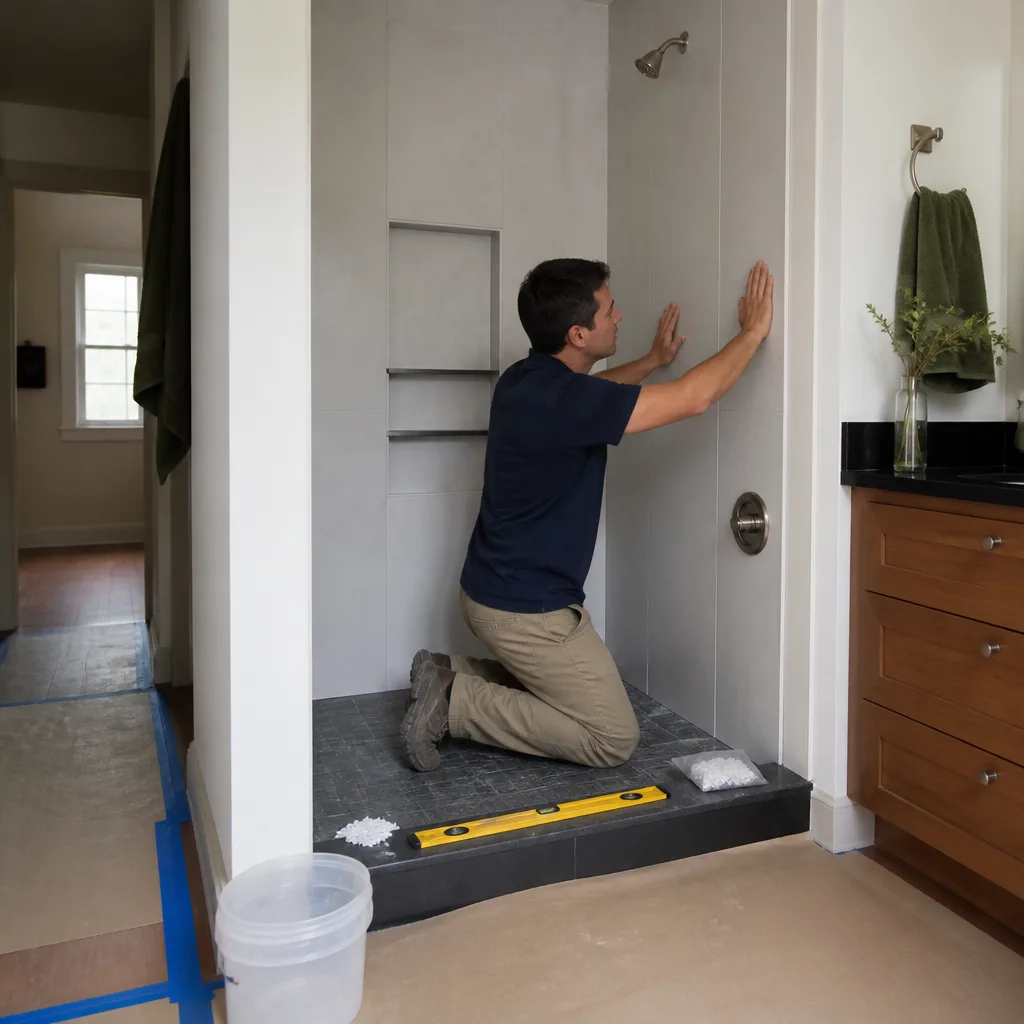
The first 12 months after a bathroom remodel are the ones that decide whether the tile job lasts a decade or fails in four. That’s the schedule: 30-day inspection, 6-month exhaust and supply-line pass, annual grout reseal and valve test, 3-to-5-year caulk and seal replacement. The work you do at each pass is small. The work you skip at each pass is expensive. That’s the point of the written schedule most contractors don’t hand you.
At Bradford Remodeling Co Concord, we put every promise in writing before work starts, backed by The Garrison Standard and the Garrison Partners family, held to the Garrison Code at every job site. Premium finishes like KraftMaid and Wellborn cabinetry, Cambria and Caesarstone surfaces, and Kohler and Moen fixtures come with documentation, and the 365-Day Done Right Promise stands behind the installation for a full year.
If you’re planning a bathroom remodel in Concord or need to know where your current bathroom stands, call (866) 476-6447 for a free estimate. We’ll write down the schedule and the guarantee before any tool comes out. That’s squared away.
Written by the team at Bradford Remodeling Co Concord.
See the difference
 Before
 After
 Before
 After
 Before
 After